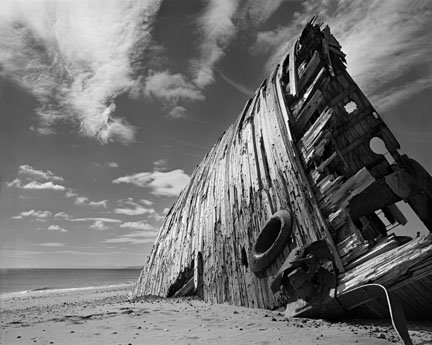
 This is the bow section of the Pesuta on Graham Island, it was a 264 foot long log carrier and was wrecked December 11, 1928. I made my first visit to these magical islands in September of 1993 and made this photo with my 4 x 5 view camera and a 120mm Schneider lens. Once there, I was captivated by the serenity of the place after a 6 1/2 hour ferry ride across Hecate Straight, I felt I had arrived in some sort of exotic foreign land. I made my second trip in 1997 when I was part of a group of five kayakers who made a 100 mile journey to the south part of the islands, on that trip I took about 80 pounds of camera gear which included my 4 x 5 view camera, but that is another story.
Friday, June 30, 2006
Queen Charlotte Islands Shipwreck
This is the bow section of the Pesuta on Graham Island, it was a 264 foot long log carrier and was wrecked December 11, 1928. I made my first visit to these magical islands in September of 1993 and made this photo with my 4 x 5 view camera and a 120mm Schneider lens. Once there, I was captivated by the serenity of the place after a 6 1/2 hour ferry ride across Hecate Straight, I felt I had arrived in some sort of exotic foreign land. I made my second trip in 1997 when I was part of a group of five kayakers who made a 100 mile journey to the south part of the islands, on that trip I took about 80 pounds of camera gear which included my 4 x 5 view camera, but that is another story.


Wednesday, June 28, 2006
Valley of the Ten Peaks
 I made this image of a cloud and mountain peak on a fine day in September in 1989 while hiking in The Valley of the Ten Peaks area part of Banff National Park. Most people access the area from the Moraine Lake parking lot which is what I did, I don't recall a whole lot of that day , but I can remember seeing the cloud hovering over the mountains and thinking that it would make a nice photograph, the picture was shot on Kodak T-Max 100 4 x 5 film and my Tachihara view camera with the 120mm lens.
Sunday, June 25, 2006
My Upside Down and Backwards Point of View
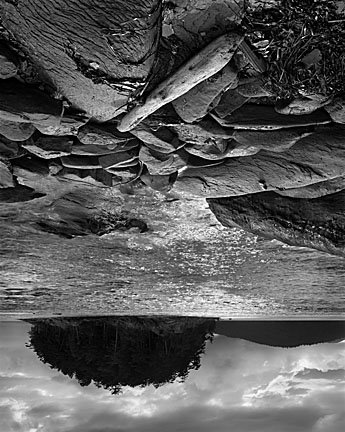 I thought I would take one of my images and present it upside down and backwards, just the way I saw it on my view camera's ground-glass when making this picture on Mayne Island in October of 2004 with my 8 x 10 view camera, at the bottom of this post is the image right side up and reversed. I have to say that when I first started shooting with view cameras about 20 years ago it took me a while to get used to composing an image this way but it also forced me to try and think in my mind's eye what my composition should look like. I think the upside-down-backwards image is very beneficial to composing a photograph, because I look at the various elements in the scene in a abstract sort of way. It has been said that to help painters with their composition that they should turn their paintings upside down, my images from the view camera are naturally upside down which gives me a unique point of view.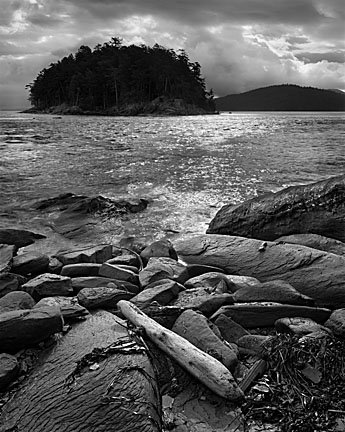
Friday, June 23, 2006
The Magical Kludahk Forest
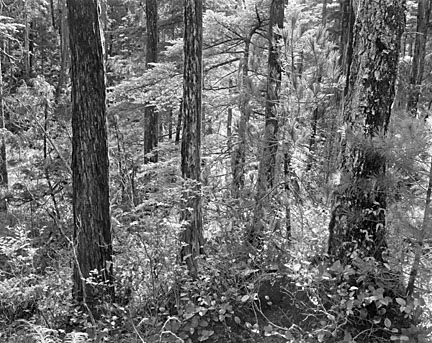 I made this image of the forest along the Kludahk hiking trail on Southern Vancouver Island on a pleasant fall day in 2005 while hiking with other family members. The trail is very beautiful with ancient old trees and stunning views of the Juan de Fuca straight. When I made the picture my eye was drawn by the back lighting filtering through the trees giving me a nice tonal range for black and white, with autumn lighting pretty well anytime during the day is a fine time to make pictures. For me the fall season is one of my favorite times of the year to make pictures, the majority of my shooting trips takes place in September and October, the light seems to have a magical quality to it and the trees and foliage with their brilliant colors adds another dimension to my black and white images in terms of tonal range. The picture was shot on 4 x 5 Tri-X film with my Tachihara view camera and a 120mm lens.
Wednesday, June 21, 2006
Accidental Art
 Every once in a while while out making photographs I have made a few technical mistakes, they happen to the best of us ! One of the most common mistakes to make while shooting with the view camera is a double exposure, this usually happens when I forget to turn the dark slide of the film holder over to the "black" side to indicate that I have exposed the film, normally these double exposures get chucked in the garbage with a thought of " I don't want anyone to see that one " but sometimes these double exposure can look kind of cool, a serendipity of photography so to speak, a happy coincidence. The image posted is one example which I thought looked interesting, shot with my Tachihara 8 x 10 view camera and a 270mm lens with Tri-X film around Botanical Beach, part of the Juan de Fuca Marine Trail Provincial Park on Vancouver Island.
Tuesday, June 20, 2006
Long Beach Shadows
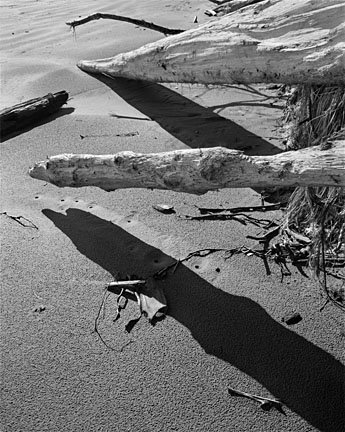 I made this images of logs sticking out of the sand this past March while on a trip with my parents to Long Beach, part of Pacific Rim National Park on Vancouver Island. Although this is an incredibly beautiful area, one of my favourite places to photograph, I always try to find something a little different even when shooting in harsh mid day light, I thought that the shadows looked kind of interesting creating strong lines in the photograph. Recent rains created a nice dimpled pattern in the sand which I thought added to the image. I made the photograph with my Tachihara 4 x 5 view camera, a 120mm lens and Tri-X film.
Saturday, June 17, 2006
A Spiritual Place
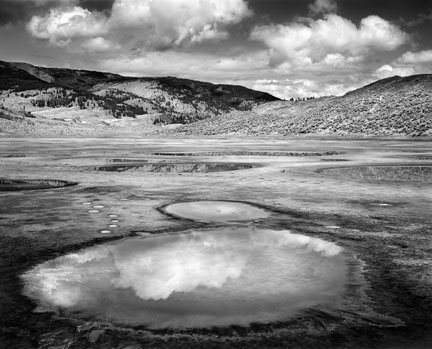 I photographed Spotted Lake near Osoyoos, B.C. In July of 2004 with my Tachihara 8 x 10 view camera and a 270mm Schneider lens and Tri-X film, its also one of the images featured in the July issue of Photo Life Magazine. The lake known to the Okanagan First Nations people as "Klikuk", is considered scared and has some unusual properties as it contains one of the world's highest concentrations of minerals. The rare natural phenomenon covers 15.2 hectares ( 38 acres ) and as the as the summer progresses the lake dries out, its mud forming into white, pale yellow, green and blue circles depending on its mineral composition which are: magnesium sulfate (epsom salts), calcium and sodium sulfates, plus eight other minerals and traces of four more, including silver and titanium. While photographing at Klikuk I felt sense of history as the first nations people had visited the culturally significant spot long before it was privately owned. The lake is now owned by the Okanagan Nations Alliance.
Thursday, June 15, 2006
My Economic Vision
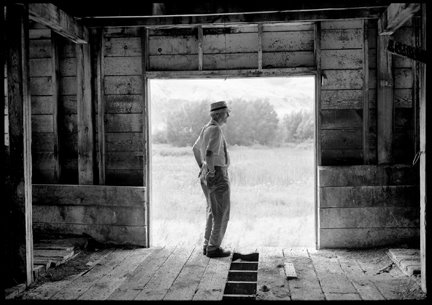 While on a recent road trip photographing along the westcoast of B.C., I started reading the book , " Walden" by Henry David Thoreau , I was reading through the section on "Economy" and I thought about my own economic situation and how it has partly shaped my vision in photography. I love to shoot pictures especially in black and white, and I have a lot of fun at it, pretty well my entire body of work over the past 20 years that I have produced outside of my job as a staff photographer for the Kelowna Courier has been in black and white. One of the reasons I shoot in black and white is that its affordable and fits my budget. Shooting in black and white on a regular basis has forced me to look at my subject matter in a different way than if I were shooting in color, at first it took me a while especially with landscapes to find interesting images that would work well in black and white, once I developed that "eye" I found all sorts of picture possibilities around me. One of the things with shooting film is that there has always been a cost difference between black and white and color film , going back in time when black and white film was the only medium available photographers had to develop an eye for making good black and white images which shaped their final vision.
Going further here with this thought, in this digital age what does the future hold for photographers who wish to create black and white images with their digital cameras ?, at the time of this writing there is no cost difference in shooting in either color or black and white, so why bother to shoot in black and white in the first place ?, if something looks interesting it can always be converted later from the color image. So if not having to shoot in black and white on a regular basis, will future photographers develop that special eye for black and white images ?
The above image was taken in Osyoos, B.C., of my Uncle Lewis with a Fuji GW690III roll film camera and a 90 mm lens ( Kodak T-Max 120 film ).
Tuesday, June 13, 2006
Misty Mountain
 This is another image that is featured in the July issue of Photo Life magazine, the image was taken with my 4 x 5 view camera and a 300mm lens in the Bella Coola valley in B.C. I liked the misty clouds that hovered around the peak of what I believe to be Mt. Purgatory at the end of a rough logging road , the trees on the left helped compose the image and give a good range of grays from black to white. When I look for possible images that will make good black and white photographs I try to find elements that occur in the natural landscape, in this case, clouds, trees and a mountain side that will translate well into black and white , on that misty rainy day in the mountains I found a nice image waiting for me.
Monday, June 12, 2006
Ellison Provincial Park
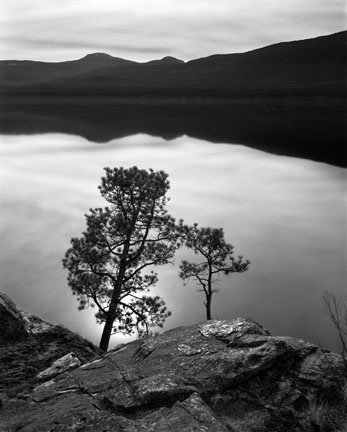 I have been away for the past week , photographing along the B.C.'s Sunshine coast and Hornby Island. The above picture is one I made back in 1989 at Ellison Provincial Park near Vernon, B.C. on a nice early spring day with my 4 x 5 view camera and a 120mm lens. The photo is also one of six featured in the July Issue of Photo Life magazine.
Saturday, June 03, 2006
Frozen in Time
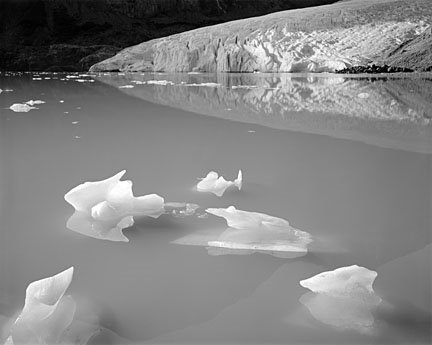 This is Bear Glacier near Stewart, B.C. and is very easily accessible because it's right beside Route 37A, this enabled me to return to the glacier at different times of the day, to study it's characteristics. I found in the morning just as the sun was coming up was a beautiful time to make pictures because the water was so still, by the afternoon winds causes ripples on the waters surface. Upon reflecting on this glacier its sort of like Mother nature's frozen moment in time from the distance past as much of the water was possibly frozen hundreds or maybe even thousands of years ago and even though with my camera I'm taking a different kind of moment frozen in time, the glacier has far more secrets to reveal.
Friday, June 02, 2006
Mechanical Still Life
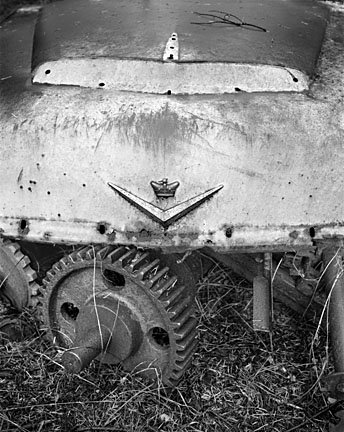 I like making pictures of found objects like this old car hood sitting on top of old machinery at my uncle's property in Metchosin. These kind of mechanical still lifes interest me, and I like to find them just as they are in their "natural state" I ask myself where did these old parts come from and when the hood was on the car and it was complete vehicle, who owned it and where did they travel with it ? The picture was made with a 4 x 5 view camera , a 120 mm lens using Tri-X film.
Thursday, June 01, 2006
Contemplating My Surroundings
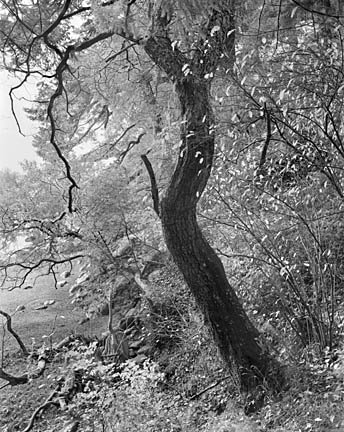 I grew up on Southern Vancouver Island and although I moved away from the beautiful Island quite a number of years ago and now live in the equally beautiful Okanagan, I like to visit quite often. One place that I like to photograph and is not far from my parent's home is Witty's Lagoon Park, which includes Tower Point, on just about any day you find Sea Lions basking on the rocks not far from the shore. While contemplating the area on a bright overcast fall day in October of 2005 I was struck by the number of Oak trees bent and twisted into various forms and loved the look of the trees at the edge of the sea, the foliage on the surrounding bushes had started to turn a nice shade of yellow, adding contrast to the scene. On a thoughtful note, one of the things for me as a photographer is to constantly challenge myself to see my subjects and surroundings from a different perspective even places that I have visited on a regular basis, there are pictures hidden where ever I might be photographing its up to me to find them. I made the image with a 4 x 5 view camera ( Tachihara ) , a 120mm lens and the film holders were loaded with Tri-X .
Subscribe to:
Posts (Atom)