Wednesday, May 31, 2006

A Memorable View

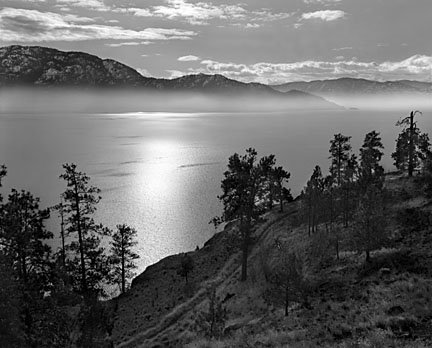
I made this personally memorable view of Okanagan Lake near Peachland, B.C. in January of 1987 with a 4 x 5 view camera and a 120 mm lens and Tri-X film. On the day that I made the picture I was out for a drive and was heading south down Drought Hill on Highway 97 and saw this beautiful light playing out over the expanse of the lake, I pulled my vehicle over to the side of the road, hiked down a side road and found a spot to set up the camera, I think I only made a couple of exposures before the light disappeared, but I felt I had captured a wonderful image which gave me confidence in using the view camera.

I bought the 4 x 5 camera in 1986 and I had not used anything bigger than 35mm film format, I was not having a lot of success. I was at the point where I thought I might give up on it, given the fact that everything was so different from using the smaller 35mm format. With perseverance I over came the difficulties and have come to love using the large format camera.

Monday, May 29, 2006

My Black and White Vision

I love the colors that is I see in the world around me but my passion has been to create images in black and white from the world around me. Way back when I first started my newspaper career I shot all my assignments in black and white and on those are days off and holidays I loved nothing more than to load my Nikons with Kodachrome slide film and find interesting things to make pictures of in color. As my artistic vision matured I started to appreciate the black and white medium more and more, interestingly, my newspaper assignments had shifted to the use of color images ( and now digital ).

Early on I was inspired by the work of Ansel Adams, Edward Weston and Henri Cartier Bresson among others, I found their use of black and white film, beautiful compositions and dramatic lighting very inspiring. One of the things that I have had to learn is to "see" in black and white and I found it difficult at first to translate what I saw in color into black and white imagery, I was so used to visualizing my pictures in color. With time and practice I think I have learned to see a little of what the great masters saw in their own world, but I'm still learning to see something new every day.

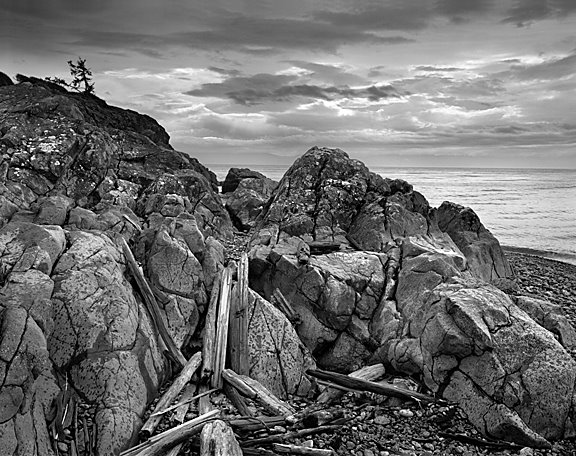
The above image was taken at Otter Point near Sooke on Vancouver Island, I made the photograph with a 4 x 5 view camera and a 120mm lens on Tri-X film.

Sunday, May 28, 2006

Approaching Storm, Sombrio Beach

I made this image of Sombrio Beach which is part of B.C. Park's, Juan de Fuca Marine Trail on the southern part of Vancouver Island in October of 2004. I spent the better part of the afternoon exploring the beach which I have done on many occasions in the past but always seem to find something new and interesting to photograph. The day started out sunny and clear but by the end of the afternoon storm clouds started to gather and the clouds slowly obscured the sun leaving a bright band of light along the horizon, with the rain starting to come down, I set up my 8 x 10 view camera and composed with the rain soaked beach rocks in the foreground and made the exposure before it started to rain too hard, as I was down to my last sheet of film.

Saturday, May 27, 2006

The Natural Lines of Composition

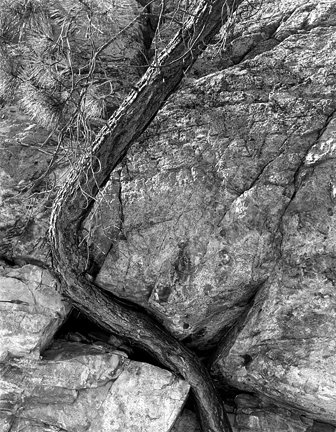
One of the things that I like to look for when composing my landscape images is naturally occurring lines, whether its mountain ranges, lakes, rivers, rocks, trees or any other natural form in the landscape. Finding the right composition sometimes takes a bit of searching and other times the composition falls naturally into place. This image of the tree is a good example of composition falling naturally into place and was taken at Skaha Bluff Provincial park near Penticton, B.C., a popular rock climbing area, when I first saw the tree on a hike with friends I didn't have my view camera with me and came back at a later date to photograph the beautiful old tree using a 120-mm lens on the 4 x 5 view camera.

Friday, May 26, 2006

A View From Above

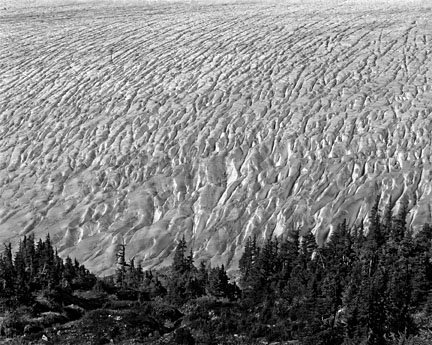
I made this view of the Salmon Glacier located near the town of Stewart in the north west part of British Columbia in September of 1993. I had been told about this spectacular glacier while visiting the area so I had to check it out, a mining road is built right beside the glacier and offers many fine views.

What struck me about the glacier was the shear huge size of the ice sheet, I wanted to make some pictures that somehow illustrated this immensity . It has often been said with photography its not what is included in the picture frame but what is left out and I did this by leaving out most of the glacier and just photographing a small partition with a medium length telephoto lens ( 300 mm ) on my 4 x 5 view camera.

Wednesday, May 24, 2006

The Little Things in Nature

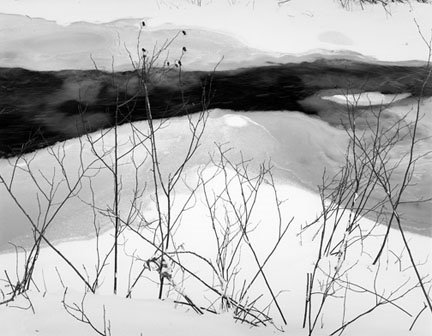
I like to try and find simplicity in my compositions while photographing nature. I made this image with my 4 x 5 view camera on a tripod not far from my home along Powers Creek. When I made this picture I was photographing another part of the ice bound creek which I though was my best image and at first I wasn't aware of other images around me but as I spent more time contemplating my surroundings I became more aware of other picture possibilities. I was concentrating on the "big picture" but after being still and letting the surrounding environment speak to me, I found it was the little things in nature that made the best picture of the day.

Monday, May 22, 2006

The Transformation Tool

The tools in the picture along with this post was taken with a 4 x 5 view camera and a 120 mm lens in my Uncle Stuart's garage in Metchosin on Vancouver Island, he uses them to make things out of metal and wood, an artist in his own right. I have written in a previous post about the tools of my photography, I think one of the greatest photographic tools to come along in the later half of the twentieth century is Photoshop.

As a staff photographer for the Kelowna Daily Courier I have used Photoshop since 1994, but it was not until two years ago that I gave serious consideration to using this creative software tool in my personal photography that like I do on my time off. I have to admit that it has completely changed how I create my images after I have made my exposures because it has allowed me to take the developed images in the form of large format negatives and transforming those scanned images by lightening and darkening exact areas on the computer and to finalize the vision that I had in my mind's eye into beautiful prints.

Saturday, May 20, 2006

"The world is not my own....

....I'm just a passing through" , those words were penned by musician Tom Waits from his song, "Come On Up to the House". As the song played I reflected and thought of my own journey through this world and how I have used my camera to try and capture a few of the fascinating and beautiful things that I have come across, whether its some beautiful landscape scene, people I have met or interesting things that people have made. I like to think of my pictures as sort of a photographic diary capturing moments of time. I also would like to think that one day my images will be of interest to others from some of the interesting stops that I have made during my journey through this world.

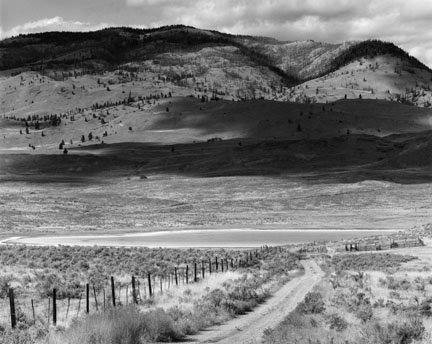
The above picture was taken around the White Lake area near Penticton , B.C, in 1992, I liked the look of the barren hills and rolling ranchland. This image was made with a Tachihara 4 x 5 view camera and a 300mm Schneider lens.

Friday, May 19, 2006

Lake Agnes, Banff National Park

I made this image of Lake Agnes situated in the Canadian Rockies near world famous Lake Louise during on a cold September day in 1989. I had been camping at Kicking Horse camp ground for more than a week. Half way through my trip I had one miserable day of weather and the next day when I woke up in the morning I peered out my tent and could see the snow on the surrounding mountain peaks.

I knew there would be a good opportunity to make some nice mountain images with fresh snow if I could get up to the higher elevations as quickly as possible. I drove to the Lake Louise parking lot and headed off up the 3.5 km long trail to the tea house at Lake Agnes. When I arrived at the lake, I took one look at the scene, and saw one image which in my mind's eye seemed to stand out with three elements: the snow covered foreshore, the lake and the mountains in the distance, I quickly set up my view camera and was happy to make several exposures of such a beautiful scene. By the time that I finished making this picture the snow had started to melt but I will always treasure this image for the rest of my life.

Technical info: 4 x 5 Tachihara view camera, 120 mm Schneider Lens, T-Max 100 film.

Thursday, May 18, 2006

The Tools of My Trade

The photograph to illustrate this post are tools from my Dad's tool box during his days as at Auto-body repairman. My photography involves using tools of a different sort, everything from digital cameras for my photojournalism work to view cameras that use film up to 8 x 10 inches in size for my fine art work. I love using my tools just as much as the next photographer and find certain cameras and lenses inspiring to use but the camera is just a means to the end. I always like to think that the picture starts out as a concept in one's mind and the camera gives me the ability to take that concept and turn it into a photograph that others can see and respond to.

Monday, May 15, 2006

My Artistic Vision: A work in Progress

I think one of the most difficult challenges for an artist is to fine one's own "vision" and over the years my artistic vision has been a work in progress. My work has changed over the years, years ago I loved to photograph landscapes with Kodachrome slide film, but one day I came to point where I felt that the Kodachrome film didn't fit my vision and longer, so I started shooting my landscapes in black and white because I felt it was closer to what I wanted to express in my prints. I also decided that I wanted to to expand my vision to include other subjects, still lifes, nudes and portraits. For the foreseeable future I don't see myself wanting to change from shooting black and white film, but the way I interpret my subjects may change as long as I am having fun.

Sunday, May 14, 2006

Thanks Mom....

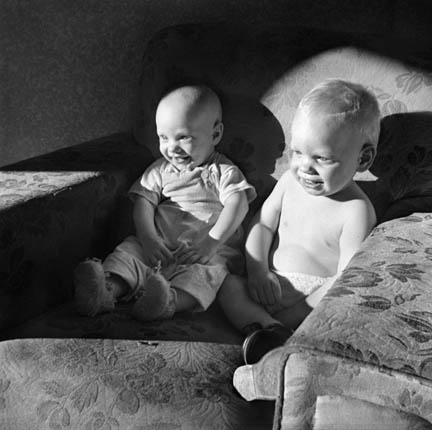
In recognition of my mom on Mother's Day, I'm posting a picture that my mom took of myself ( I'm on the right ) and my brother Ron sometime around 1959 in Victoria, B.C., I recently scanned a large batch of my mom's old black and white negatives from an extensive collection of snapshots that she had made with her Kodak Brownie box camera in the 1950's and 60's, This image is one of my favourites with the sunlight streaming through a window with us two little rug rats sitting on the sofa chair.

Saturday, May 13, 2006

South Beach, Vancouver Island

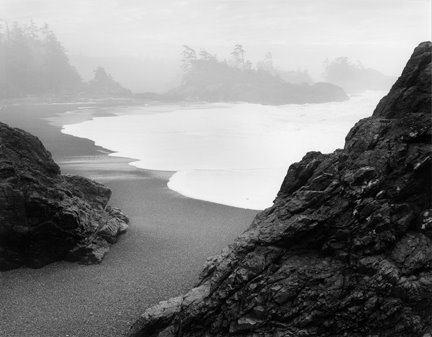
I came upon this wonderful scene in area called South beach while on a four day trip to Pacific Rim National Park on Vancouver Island in October of 2003. The day was a typical west coast kind of a day, rainy and foggy.

There was a wonderful feeling in the way the clouds were starting to break up and the light starting to to break through after I emerged onto the beach from a forest trail, I pretty well had visualized in my minds eye how the image would look, the black rock at the right just seemed to balance out against the misty skies and the foamy water on the left. I felt a sense of tranquility when I made the exposure with my view camera , because every thing just seemed to fall so naturally into place. I was happy to be there.

Technical details are: 4 x 5 Tachihara field camera, 120mm lens, I don't remember the exposure, Tri-X film developed in HC-110.

Friday, May 12, 2006

My Mimimalist Photography

I have always tried to approach my work with a minimalist idea in regards to my work, when I go out making pictures with my 4 x 5 view camera, I usually only pack two lenses, a medium wide angle and a short telephoto, its not that I would not find more lenses useful its just that I do not want to be distracted by the burden of having too much equipment, I want to be able to focus on the subject and let it "talk" to me and not be distracted by having to figure out which lens to use in order to interpret the scene before me.

Thursday, May 11, 2006

The Art of Change


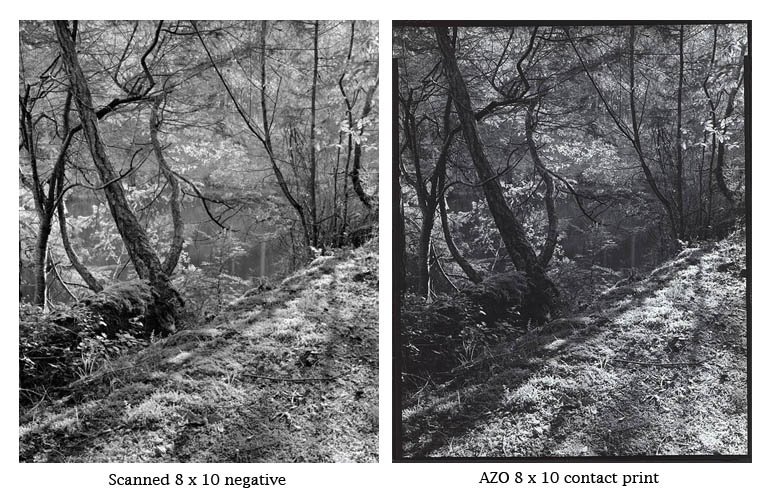
Here are some of my thoughts on how I print and the changes that I have experienced in the past couple of years as I went from making prints with photographic black and white print paper in a darkroom where I was content to while away the hours hovering over trays of developer, stop bath and fixer to making prints from the same negatives scanned into a computer and printed using an ink jet printer using various kinds of fine art papers.

One of the things that I really like about printing digitally is the amount of creative control that I can achieve by using photoshop , I can enhance selected parts of the overall image, lighten or darken certain areas, I can also zoom in on the image and clone out all the annoying dust marks. As an artist I feel I can produce more accurately what I saw in my "mind's eye" as to how the finished print should look. I have posted couple of my images, one scanned digitally and the other printed in the darkroom, each print has its only unique characteristics.

Wednesday, May 10, 2006

The Printing Machine

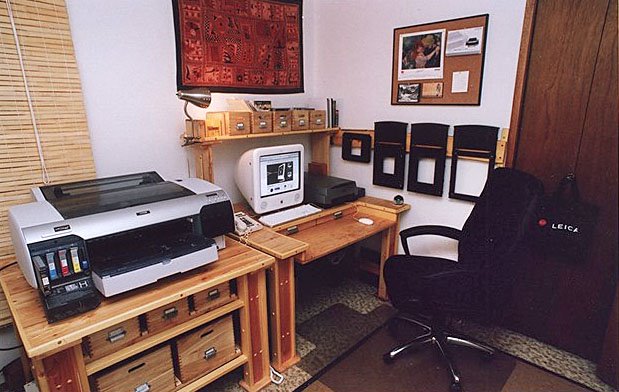
This is my Epson 4800 printer which I am currently using to make my prints, I bought this printer last year after having traded in an earlier model the 4000, previous to that I made darkroom prints. I like the black and white print quality from this printer, but really its only part of the equation, as its only a machine that is given a set of commands to print something. Photoshop is another factor, but it's still the artist with a vision starting before the exposure is even made.